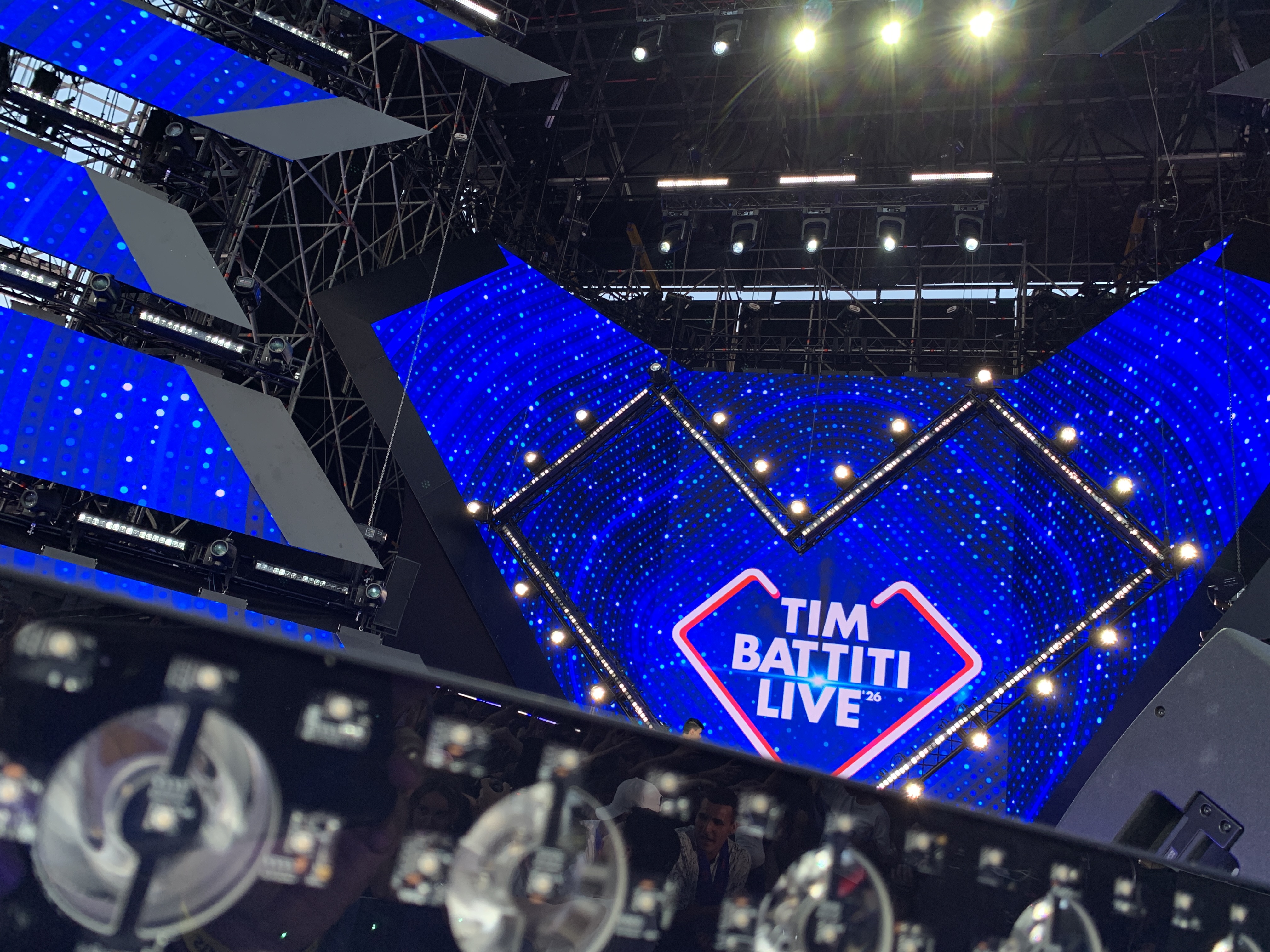
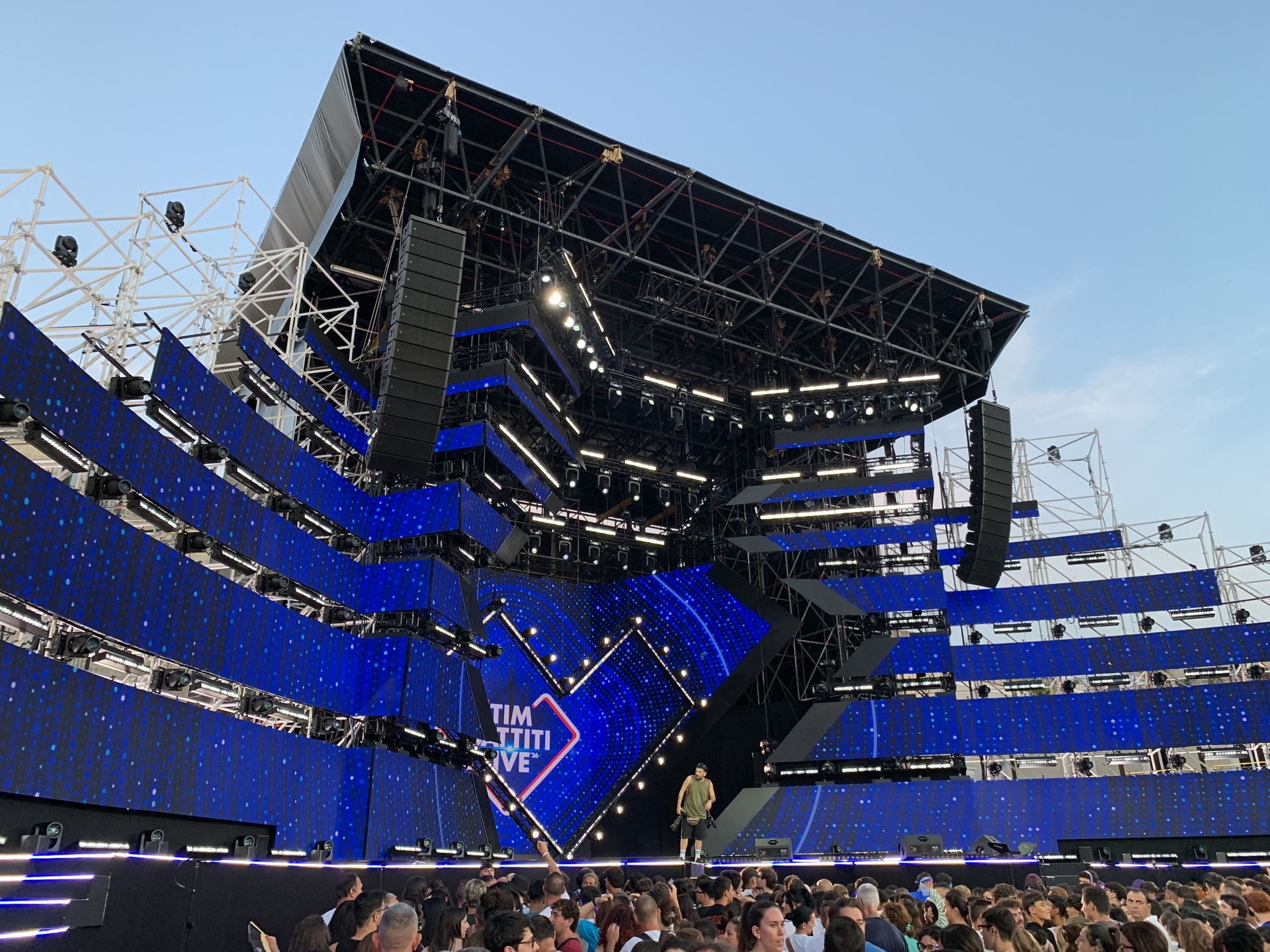
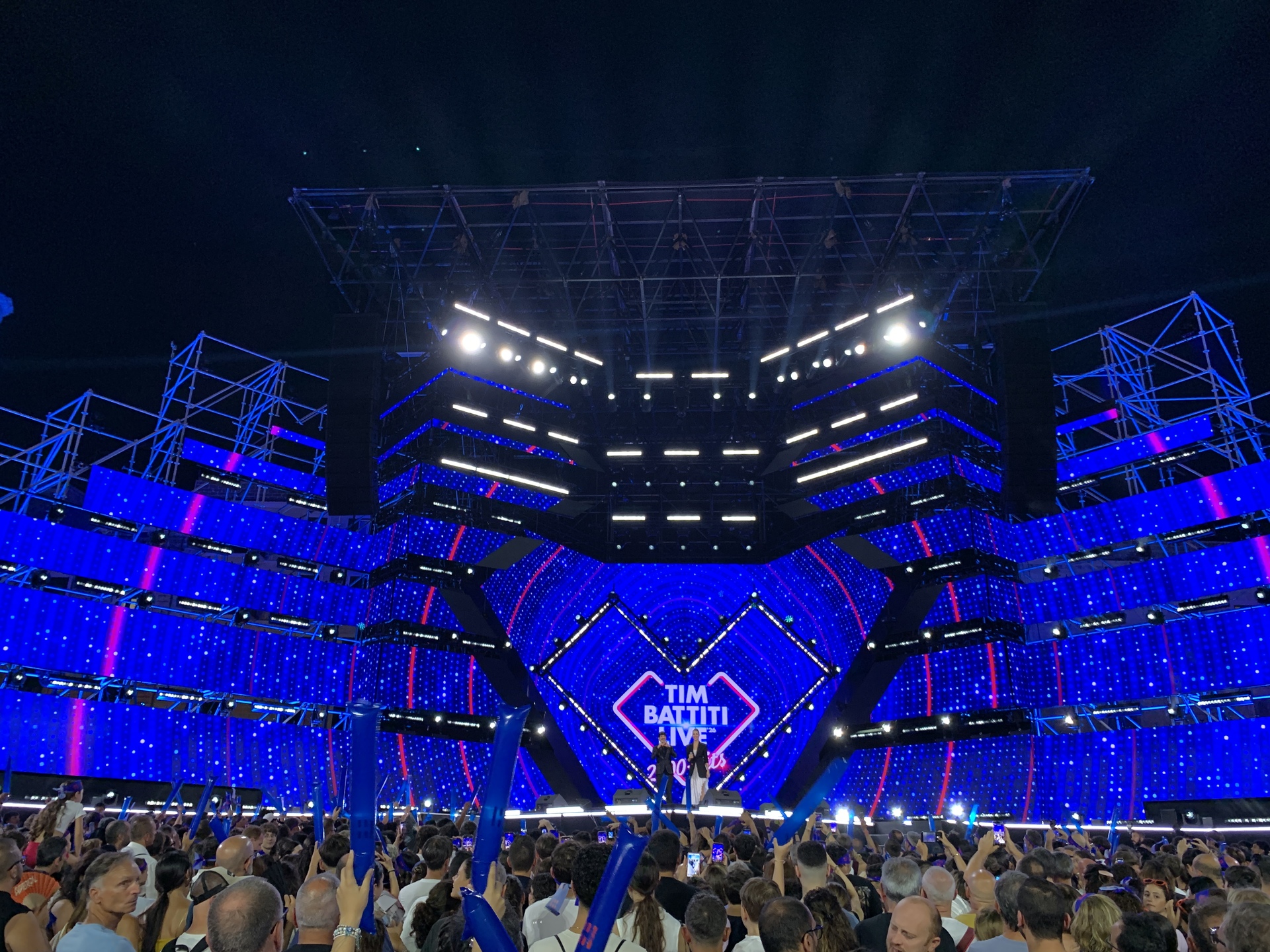
TIM Battiti Live, the most anticipated music event of the Italian summer, returned to the squares of Puglia once again broadcast by Canale 5. As it does every year, it was preceded by Road to Battiti, the itinerant tour that travelled through Manfredonia, Martina Franca, Bari, Alberobello and Polignano a Mare before the main event opened in Piazza Quercia in Trani, on the seafront, where more than seventy artists performed. Genetiko produced both, with STS Communication on audio, video and lighting technical delivery, Lucidiscena supplying the PROLIGHTS fixtures on dry hire and Massimo Pascucci as Director of Photography.
"STS asked me for support on a set of fixtures they needed, and I have known Massimo a long time, so I suggested the new HaluPix Duo to him," said Pino Loconsole of Lucidiscena. "He had used Halu Pix before, so he knew the family. He looked at the specifications, tested the HaluPix Duo to see it in person, then chose it and built it into the virtual set design. Massimo is a true professional, he has been working in television for more than forty years, so his opinion counts for a lot."
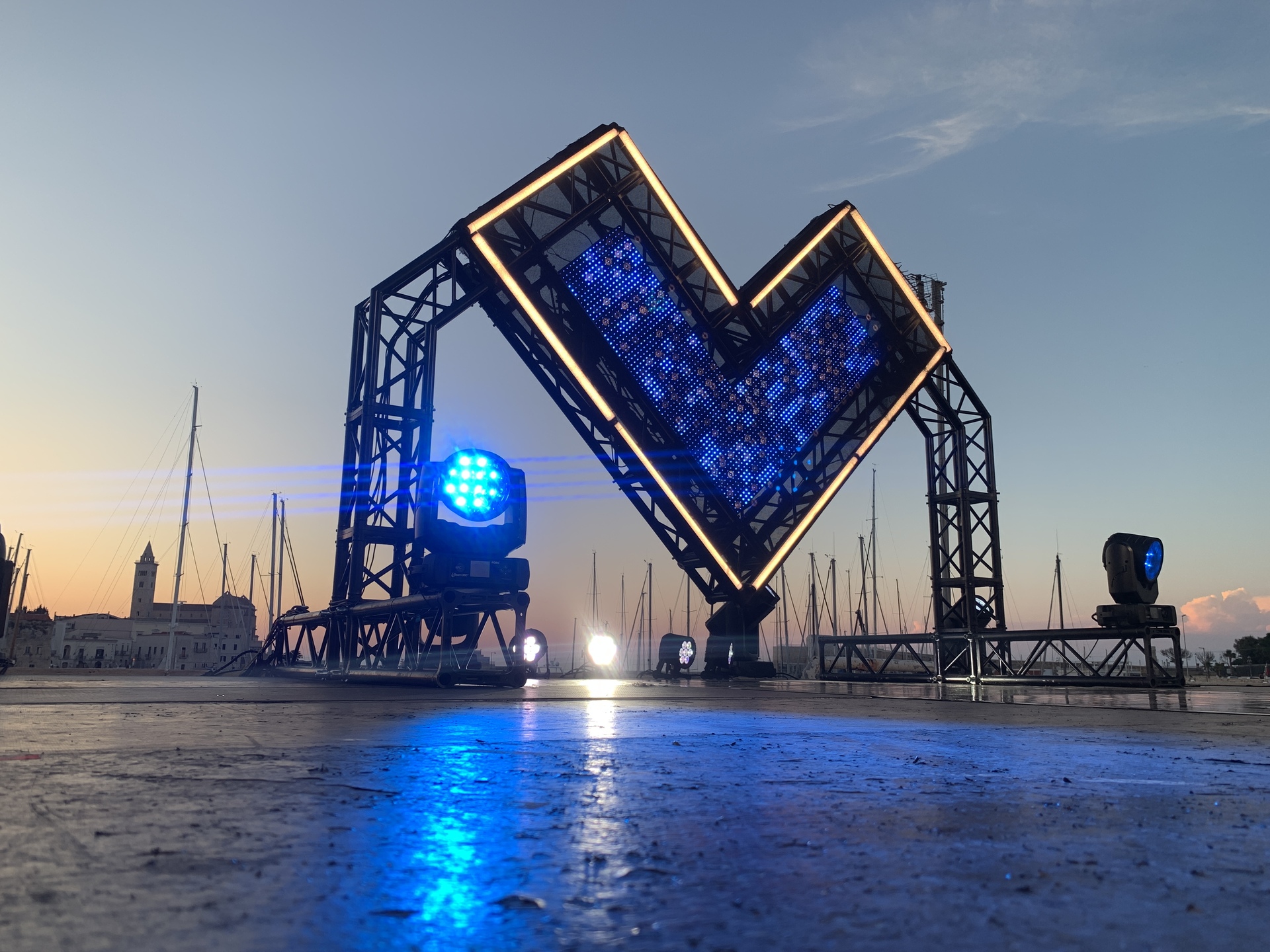
The real challenge on Road to Battiti was time. Five back-to-back dates across five towns, most of them without the infrastructure a television production normally counts on, left almost no margin for set-up. The solution was to move the build off the road and into the warehouse: 24 HaluPix Duo LED panels were assembled, cabled and addressed before the tour left, so the totems went straight from the truck to the stage, ready to go.
"My concept needed a fast, immediate installation, but one with real visual impact," explains Massimo Pascucci. "We had to be ready by the evening after starting in the morning, so no time at all, and at the same time the setup had to be top level: we're talking about primetime on Canale 5, with all the expectations that brings. I had been looking for this dual solution for a long time, and I finally found exactly what I needed. That's where the idea came from: transporting the totems already cabled and up and running."
Three HaluPix Duo were rigged on each of eight trusses, interleaved with strobes that were mapped as video alongside them so both received identical content. The panels were arranged in a geometric configuration that read on camera as columns of light, animated with multicolour graphics that gave the touring show its visual signature. They were patched twice, running 256 DMX channels for conventional control alongside 1,600 Art-Net channels for pixel content, so effects arrived from the console and from a media server in parallel.
"Massimo wanted something new, but it had to be quick to set up in those conditions," said Antonio Larosa, Technical Manager at STS Communication. "Pre-rigging in the warehouse meant that on site we only had to build the towers for the artist lighting. It also let us use the fixtures for everything they can do, because they arrived cabled in both DMX and Art-Net."
For the TIM Battiti Live main stage in Trani, Pascucci returned to the same family. 36 HaluStrip Duo LED bars replaced fixtures already specified in the design, 30 of them flown in the upper part of the set above the heart that has become the show's signature scenic element and 6 standing at floor level. A further five HaluPix Duo went to Stage Left, the second set on the Lungomare Cristoforo Colombo, placed at the centre of the heart that framed the shot where presenters interviewed artists before they went on.
"Massimo was very satisfied with how the panels had performed on the road, so he decided to use them again," Loconsole said. "The project was already drawn up, which meant replacing components and putting HaluStrip Duo in place of products that had been specified earlier."
"I've always been obsessed with detail and the finer points, which is why I also made use of the filters available to me," Pascucci adds. "On the main stage, I chose to mount them behind a black tulle set about 20 centimetres away: I softened the light source slightly, making the mapping effect extremely elegant."
"I was really impressed by the HaluStrip Duo," Larosa added. "Hung above the stage and run as strobes they put out more light than anything else we had in that position, and they are small and light enough to go almost anywhere. If I had to choose new fixtures, those would be the ones, a versatile product, also with a view to possible future LED implementations."
Both models are built on the same dual-layer principle and differ mainly in scale. HaluPix Duo is a 50 cm modular panel carrying 441 RGB+WW pixels at 120° alongside 49 warm white 4° beam sources, drawing 500 W in wash and peaking at 1,200 W in strobe. HaluStrip Duo puts the same architecture into a one-metre IP65 bar with 126 pixels and 14 beam sources, fan-free and 8 kg, with retractable feet for floor positioning. Every emitter is individually addressable, so one unit can work as beam source, blinder and video surface at the same time.
Across both productions, HaluStrip Duo and HaluPix Duo answered the two things television demands most: accurate colour and visual impact on camera, holding sharp definition in both the graphic detail and the light beams, live and at home. Whether on the fast-build touring rig of Road to Battiti or the large main stage designed for primetime, PROLIGHTS fixtures proved their versatility in every setting.
For more information, please contact: marketing@prolights.it.